Stand out from the crowd and level up your side hustles today!
Why I Left Adobe After 25 Years — And Why This Is a New Chapter for Me
After 25 years using Adobe, I finally cancelled my subscription. This blog shares why rising costs, quiet price hikes, and changing creative workflows pushed me to rethink always-on software—and how this shift is shaping a new chapter of teaching simpler, more accessible tools for everyday creators.
Sparksociallab
2/10/20263 min read
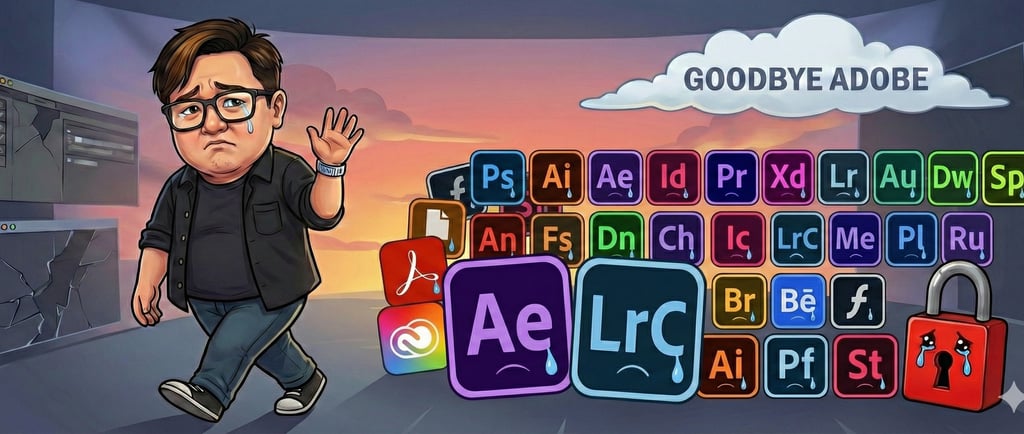
Leaving a creative tool you’ve used for 25 years isn’t an emotional decision.
It’s a practical one.
I didn’t wake up one day angry at Adobe. I didn’t “quit” out of frustration. What happened instead was a slow accumulation of small signals that eventually became impossible to ignore. This post isn’t about cancelling a subscription. It’s about how creative tools fit into today’s working reality — and how that reality has changed.
The price hike I wasn’t clearly informed about
The immediate trigger was the latest price increase, roughly 15%.
I wasn’t clearly informed ahead of time. I only realised it when renewal came around. That moment alone introduced friction where there used to be trust. Price increases are not inherently wrong, especially for a market leader, but the way they are communicated matters. When changes arrive quietly, framed as “value creation” rather than choice, they force long-time users to reassess whether the value being added actually aligns with how they work.
When I looked closer, much of that added value consisted of tools I don’t use, features I didn’t ask for, or capabilities that competitors are now offering for free or at a much lower cost. The increase wasn’t offensive on its own. The misalignment was.
Paying more while core workflows become fragmented
What made the decision clearer was watching workflows I actually relied on slowly move out of the core ecosystem.
Certain 360-related workflows, for example, were removed from what used to feel like a cohesive creative pipeline and placed into separate paid systems. The effect was subtle but cumulative. The core offering felt slimmer, while the overall cost grew heavier. It no longer felt like I was paying for depth. I was paying for breadth I didn’t need.
Over time, that shift changes the relationship between tool and user. You stop feeling supported and start feeling managed.
I don’t need access to everything, all the time
This was the real turning point.
For most of my career, creative software followed an all-or-nothing model. You either had the tools or you didn’t. That made sense in an era where alternatives were weak and workflows were rigid.
Today, that model no longer reflects reality.
I don’t need access to every tool, every month. I need access when a project requires it. I’ve built more than 20 years of muscle memory using Adobe tools. That knowledge doesn’t disappear because a subscription ends. Skills, judgement, and creative thinking are not subscription-based.
Realising that made the decision surprisingly calm.
I still love and teach After Effects
This isn’t an anti-Adobe stance.
I still love After Effects. I still teach After Effects. And when a commercial project genuinely requires it, I’ll subscribe for a month or two without hesitation. Adobe remains industry-relevant, and certain pipelines still depend on it.
What has changed is my willingness to pay for permanent access “just in case”. The default has shifted from always-on to intentional.
The modern creative landscape has changed
The wider context matters.
Today’s media environment prioritises speed, adaptability, and cost-efficiency. Iteration often matters more than theoretical perfection. There are now many professional-grade tools that may not be flawless, but are more than sufficient for modern platforms and audiences. Combined with AI-assisted workflows, they allow creators to move faster, experiment more freely, and reduce fixed overheads.
In that context, paying a high monthly fee purely to remain inside a single ecosystem feels increasingly outdated.
A new chapter: teaching beyond a single ecosystem
Leaving Adobe as a default, always-on tool marks a new chapter for me as well.
For a long time, teaching creative work implicitly meant teaching a specific ecosystem. That made sense when professional-quality output was tightly coupled to professional software. Today, that coupling is far weaker.
This shift allows me to teach in a more honest and inclusive way — especially through Spark Social Lab, which was created for the everyday creator navigating real constraints of time, budget, and access.
It allows me to focus less on software loyalty and more on decision-making, creative intent, and adaptability. In practical terms, that means being able to teach:
simpler tools that reduce friction and speed up execution
free or lower-cost alternatives that are accessible to a wider audience
hybrid workflows that prioritise thinking and storytelling over allegiance to any single platform
The goal is no longer mastery of one ecosystem, but confidence in moving between tools as projects, platforms, and constraints change.
Disappointment — and hope
What disappoints me most isn’t the price increase itself. It’s the direction.
Adobe once won because it was aspirational yet accessible. It trained a generation and grew alongside its users. That relationship feels strained today, but not broken. I still believe there is room for pricing models that reflect how modern creators actually work — modular access, project-based subscriptions, and clearer differentiation between professional, educational, and casual use.
This isn’t goodbye
This isn’t a farewell. It’s a pause.
If Adobe realigns with how creators work today, it will easily earn back my attention and my subscription. Until then, I’ll choose tools intentionally, subscribe when needed, and focus on the work rather than the platform.
For Spark Social Lab, this marks an evolution — a commitment to showing creators that great work is no longer locked behind expensive software, but driven by clarity, intention, and adaptability.