Stand out from the crowd and level up your side hustles today!
Why Long AI Prompts Used to Work — and Why They Don’t Anymore
A Spark Social Lab Editorial for Students
Jerome
12/23/20253 min read
If you’ve been experimenting with AI tools for a while, you’re not imagining things.
There really was a time when writing extremely long prompts — sometimes 300 words or more — produced shockingly good results. The images looked detailed, accurate, and impressive. So when people today say, “Keep your prompts short,” it can feel confusing, or even wrong.
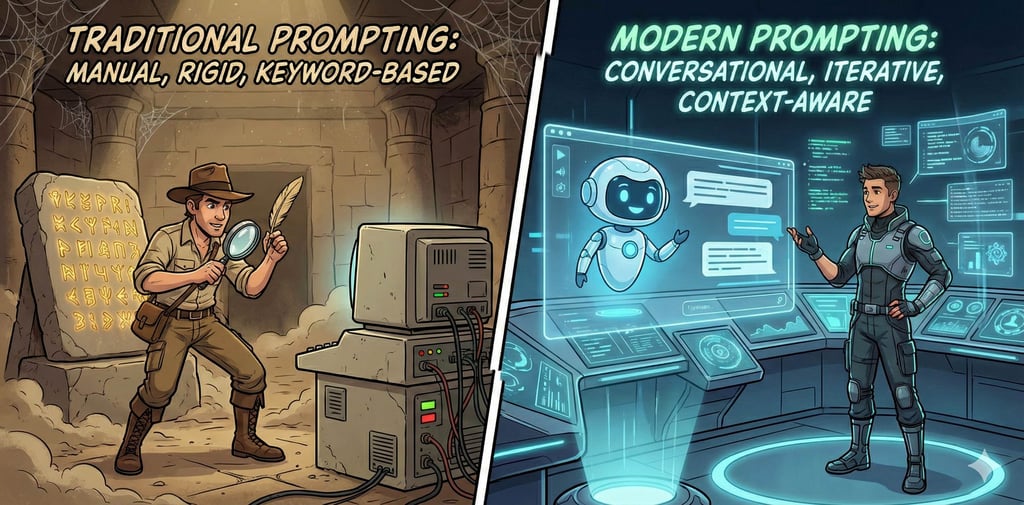
The truth is simple: long prompts weren’t bad. They were right for their time. What changed wasn’t your skill. What changed was the AI.
When AI Needed You to Do the Thinking
Early AI image models were very literal. They didn’t understand context the way modern systems do, and they couldn’t fill in missing information very well. If you didn’t explain something, the AI simply guessed — often badly.
Because of this, creators learned to over-explain. They described every colour, every texture, every lighting condition, and every detail they wanted to avoid. Prompts started to look like essays, not because people enjoyed writing them, but because that was the only way to get reliable results.
At that time, writing long prompts wasn’t overkill. It was survival.
What “Accuracy” Meant Back Then
When people said those early results were “accurate,” they usually meant that the image looked very detailed in a single frame. Textures were sharp, colours were correct, and the image looked impressive when you zoomed in.
But accuracy today means something very different. Modern AI is expected to handle movement, camera changes, and lighting consistency across time. Instead of producing a beautiful snapshot, it’s expected to produce something that feels believable as a scene.
In short, AI used to make pictures. Now it tries to simulate moments.
The Big Shift: From Drawing to Simulating
Modern AI tools don’t just draw what you describe. They build a world, place things inside it, and then decide how that world behaves when time moves forward.
This is why long prompts behave differently today. When you try to control everything at once — appearance, style, lighting, motion, camera, mood — the instructions start to compete with each other. The AI has to decide what matters most, and it will always choose coherence over perfection.
When something feels “ignored” in your prompt, it’s usually not because the AI didn’t read it. It’s because something else mattered more.
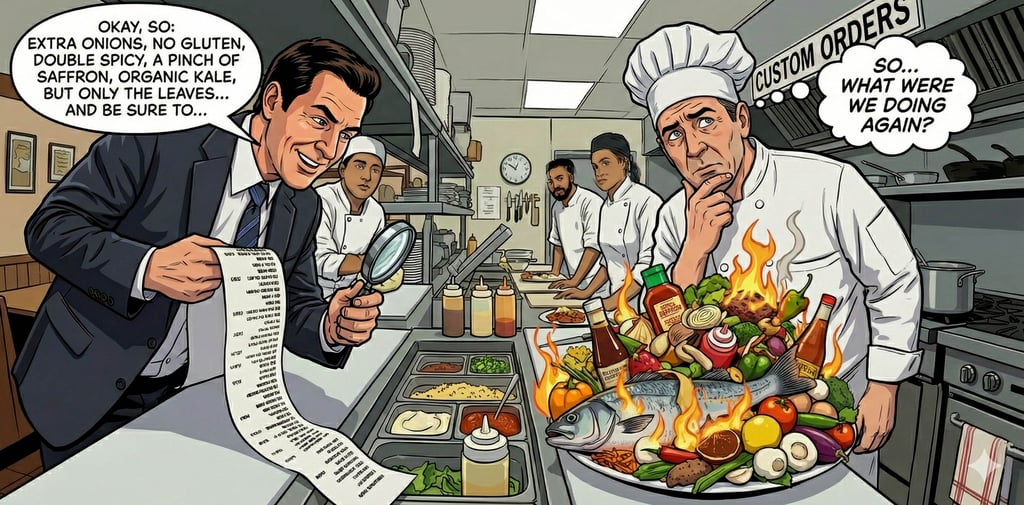
Think of It Like Ordering Food
A helpful way to understand this change is to think about food.
In the past, you had to explain every ingredient and every step of a recipe or the dish would fail. Today, you can simply say what dish you want and how you’d like it prepared. The chef takes care of the details.
Modern AI works the same way. Giving more instructions doesn’t automatically improve the result. Giving the right instructions does.
Why Long Prompts Sometimes Still Seem to Work
This is where a lot of confusion comes from. Long prompts can still appear effective when nothing is really moving, when the camera stays still, or when a strong reference image does most of the work.
In those cases, the AI isn’t being challenged very much. It’s doing something closer to what older models did — generating a single moment. That doesn’t mean the old approach scales when motion, storytelling, or video is involved.
Where Long Prompts Still Have a Place
Long prompts haven’t disappeared completely. They can still be useful in specific situations, especially when motion is not the main concern:
Text-to-image experiments where nothing moves
Concept art and early visual exploration
Learning how styles, lighting, and descriptions affect results
Building prompt libraries for future reuse
Once time, movement, or camera behaviour enters the picture, shorter and clearer prompts usually perform better.
The Rule We Teach at Spark Social Lab
When students ask us how long a prompt should be, we don’t give them a strict word count. Instead, we teach a simple rule:
Use only as many words as needed to make the idea clear
Focus on what exists, where it is, and what is happening
Decide how the viewer is meant to see the scene
Avoid repeating yourself just to “sound detailed”
The goal isn’t to control everything. The goal is to give the AI enough structure to do its job well.
Final Thought
Long prompts weren’t a mistake. They were exactly what earlier AI systems needed.
But using them unchanged today is like reading an entire recipe out loud to a professional chef. You don’t get better food — you just get in the way.
Prompting evolved because AI evolved.
This article is part of the Spark Social Lab editorial series, where we help students and creators understand modern tools without the jargon or hype.